
🛎️ Holiday travel deal alert: World of Hyatt members can save up to 25% (free to join!) on qualifying stays at more than 1,200 destinations worldwide—like Park Hyatt Cabo Del Sol (featuring ocean-view suites and a full-service spa), Hyatt Regency Maui Resort and Spa (on Kaanapali beach), The Standard, Maldives (with overwater villas), Andaz Lisbon (in the historic Baixa neighborhood), Hyatt Regency Times Square (in the heart of NYC’s Broadway Theater District) and more. Book by Dec. 8 for stays through Apr. 30, 2027.
Over the weekend, on a trip to New England, I met two of you in the wild—one in a coffee shop, another on an airplane. Both mentioned the podcast, which made me yearn to send a mass voice memo dispatch via RSS feed. In that spirit, I recorded a narration of today’s essay, which should be the first thing you see in this email. On the note of recording things, I’ve fired off a sycophantic plea for a conversation with an illustrator and data journalist named Mona Chalabi, who recently published a book called Ten Lives: How What We Have Shapes Who We Are. “What unites all 11 of them,” Rachel Clarke writes of Chalabi’s subjects for The Guardian, “is a gnawing fear for their financial futures—irrespective of how much they earn.” Here’s my favorite interview so far, on a show called Time Sensitive:
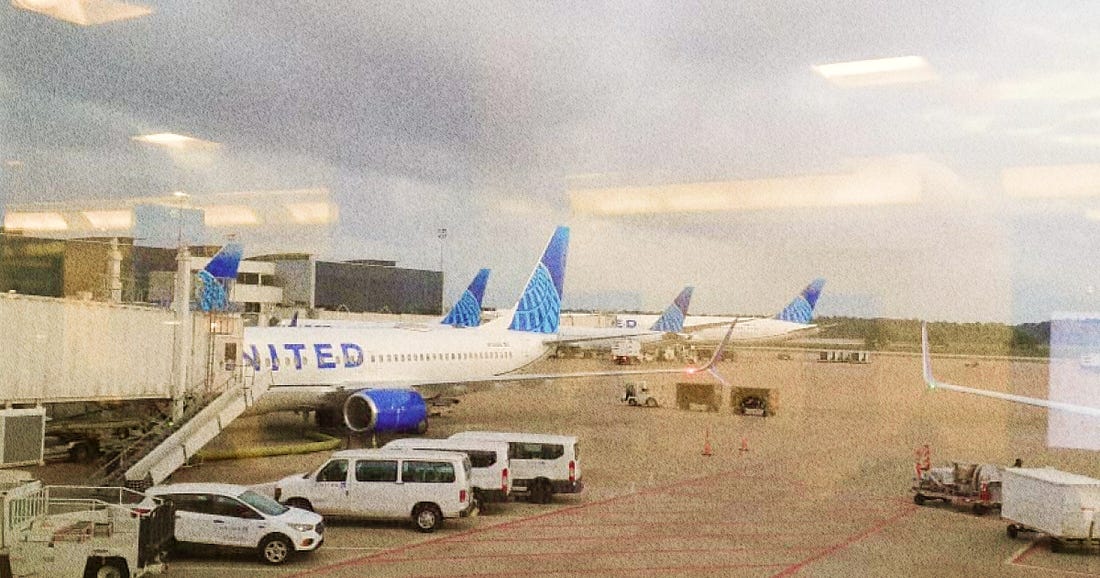
A Perfect WorldAlt. Title: A dispatch from the week when everything brokeAround 4 o’clock on Friday afternoon, after a short layover in our nation’s capital, I dragged my suitcase across the gravel driveway of a rental house in the woods. I had just arrived in Woodstock, Vermont, a New England village chartered in 1761. The town, with its Federal-style homes and steepled churches, is an anachronism. Even the power lines are buried underground, spiriting away the evidence of modernity. After settling in, I received a pileup of “Breaking News” push notifications: The FAA had ordered a total ground stop of all US flights after air traffic control communications mysteriously fritzed. I was filled with the staticky sensation of having narrowly evaded catastrophe, akin to the mix of relief and vulnerability you might feel after witnessing a car accident in an intersection you’ve just driven through.
I swiped over to the United app, expecting to see some evidence of the melee, but there was nothing—just the echo of my just-completed trip. My return trip still offered the reassurance of a kelly-green On Time badge, like the digital realm hadn’t yet registered the physical meltdown. The ground stop, the longest since 9/11, canceled more than 10,000 flights. Theories trickled in over the following hours about potential culprits: a generic communications outage in Amarillo; a sliced fiber-optic cable in Arkansas; a systemwide rollout of an AI program called SMART. Messages from the authorities were vague, defensive. The Homeland Security Secretary Markwayne Mullen, a man with a concatenated first name, blamed “aging systems” and denied foul play. A promotional box in a CNBC article published a few days later surfaced a collection of half a dozen similar stories, cheerfully prompting me to read more about infrastructure problems. (If you liked the nationwide ground stop, it seemed to say, you’ll LOVE the institutional failure across our entire democracy!) Just a day earlier, a global Microsoft 365 outage had abruptly ended the work day for millions of privately grateful officegoers the world over. Unreachable without Outlook and Teams, people celebrated. A North Carolina law firm posted a TikTok of its attorneys using desk chairs as makeshift Pilates reformers; riding bikes through the hallways; making pancakes from scratch in the communal kitchen. Social media, the global commons where the constipated emailers congregated, had the frisson of a snow day. But the timing of the meltdown—dubbed “Microsoft 364,” and which followed a massive voluntary separation offer to nearly one-third of Microsoft’s workforce in what appeared to be corporate cost-cutting’s preemptive strike—seemed like something more than just coincidence. Fortunately my weekend on a rural Vermont farm required zero Microsoft products, and by the time I flew out of Bernie Sanders’s home airport Sunday night, the airlines were up and running again. Then, first thing Monday morning, I noticed a check I had written to a local service provider for $1,000 had somehow been deposited twice, my account double-debited a few days apart. I called. They told me to contact my bank. I contacted my bank. After a labyrinthine automated menu and a 20-minute hold, a Chase representative ushered me through the obligatory set of security precautions, and then seemed to hit a snag. “We have to transfer your call.” I waited. Suddenly, a burst of language on the other end. They were speaking quickly, and, it seemed, to somebody else. “Hello?” I asked. They continued chattering away. “Sí, claro, bueno.” More indistinguishable fast-talking. “Hola,” I said. “Inglés, por favor?” I waited silently, but the animated yammering on the other side continued, punctuated with pauses and responses and commotion that sounded like a lively discussion carrying on in a busy restaurant, as if I had been patched into someone’s rowdy family dinner. Frustrated, I hung up and tried again. Finally, a new representative told me sheepishly that the bank’s systems were down. They couldn’t access my account, or really do much of anything, as a matter of fact, with the exception of answering generic questions about JP Morgan Chase & Company. I took to Reddit to see if anyone else was talking about an outage. Sure enough: “Just went into a location and they said all their systems are down and all they can do is give change,” read one post. Within hours, reports of similar issues with Wells Fargo and Bank of America began bubbling up. If you believe the government and corporate comms departments, these meltdowns—telecommunications, aviation, banks—are not the cascading result of a targeted cyberattack, but something scarier: mundane failure becoming more frequent and far-reaching. In the week leading up to this fustercluck, I started watching season 2 of Apple TV’s Dark Matter, a show about a physics professor named Jason Dessen who uses a giant, graphite-colored box to enter “superposition”—a quantum mechanics concept that refers to existing in a combination of multiple potential states simultaneously—so people can move between an infinite multiverse of alternate dimensions. Heady stuff. The variations of our reality we encounter in the show range from utopian to apocalyptic. One is nicknamed “Polite Sex World” by the characters who pass through it. Another appears to be a particularly advanced surveillance state where animatronic, curbside billboards recognize and speak to you by name, alerting your truancy officer when you’re strolling the streets during school. One can imagine countless darker scenarios for this technology, which appears barely more advanced than the 120,000 Flock cameras already installed in US cities. But the most memorable of the “worlds” that the Dessen family encounters is a reality in which JFK lost to Nixon, Nixon defunded NASA, and we never went to the moon, which means, they deduce, that we never knocked over the small domino that led to the big domino of mass-producing the semiconductor. As a result, the internet never became a ubiquitous technology. The 2026 Chicago of this reality appears frozen in the 1970s. There are no computers. No iPhones, no MP3 players, no Nvidia. For all we know, in this dimension, Jensen Huang is a tax accountant with only a single mistress. The episode is called “A Perfect World.”
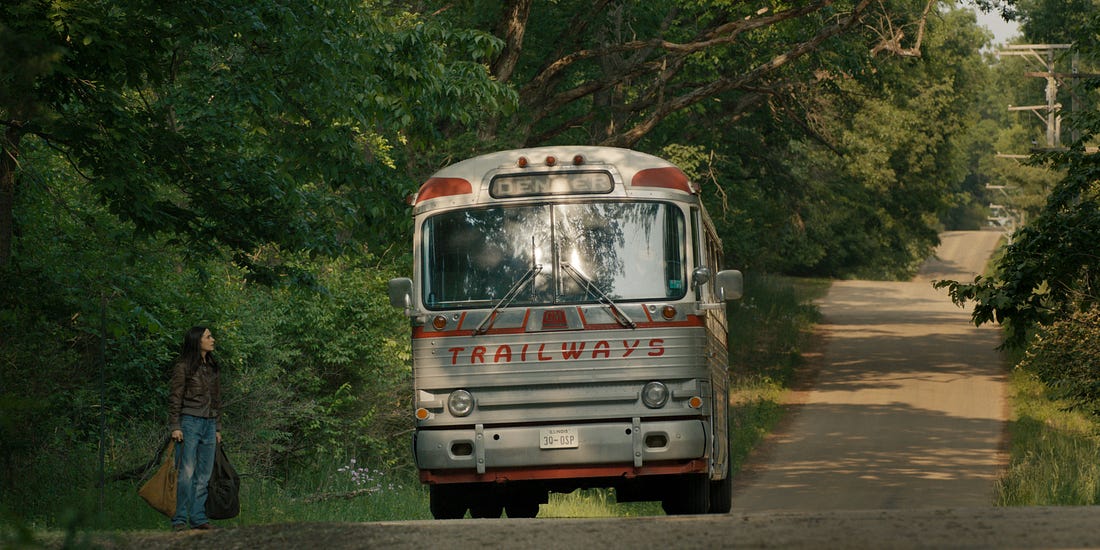
It has an immediate appeal. Scenes feature a library crawling with patrons; a bustling art museum where a crowd congregates around a famous Seurat; teenagers flirting and playing pool in some vague third space, pairing off to discuss their record collections. Orders at a local diner are jotted down with pencil and paid for with cash. A scene where Jason’s wife Daniela takes a bus from Chicago to a remote corner of Illinois implies a functional and comprehensive transit network, as though all those decades of money and energy that our reality spent on a sprawling digital landscape had instead been invested in the infrastructure of the physical world. “I wish we could vacation there,” I said, projecting myself into their analog Chicago and feeling time slow, fending off the low-level awareness that I was, at that very moment, resisting the urge to check my phone. Champions of the digital future promised it would smooth over the friction of the unwieldy physical world. When billionaire venture capitalist Marc Andreessen coined his famed, clunky metaphor that “software is eating the world” 15 years ago, he meant it as a good thing. “Software is also eating much of the value chain of industries that are widely viewed as primarily existing in the physical world,” he writes. “In today’s cars, software runs the engines, controls safety features, entertains passengers, guides drivers to destinations and connects each car to mobile, satellite and GPS networks. The days when a car aficionado could repair his or her own car are long past, due primarily to the high software content.” This, too, was a good thing, by Andreessen’s estimate, or, at least, an inevitable one. Financial services, healthcare, communication: In these fields and more, he saw an opportunity to apply a glittering sheen of zeroes and ones. “I know where I’m putting my money,” he concludes, and development followed suit. “Software is eating the world” was less a prediction than a decree: The businesses that get funded are the ones that get built. It’s understandable that Marc, a venture capitalist whose job description is make money, was excited. Software products, like financial ones, offer extraordinarily high returns on investment when compared to hard cost-constrained physical goods and services. Capital tends to seek the path of least resistance, blindly flowing toward these opportunities and ignoring the hard, slow stuff. In this context, what’s deemed “valuable” can seem nonsensical, derivative. An example: During the pandemic, United Airlines needed to borrow money. It put up its loyalty program—a membership club mediated by a pseudo-currency called MileagePlus points and powered by a credit card with Chase—as collateral. The loyalty program was assessed to be worth more than the airline itself. (As I started writing this essay Monday afternoon, there was another alert from the Associated Press: United Airlines had reported a systemwide outage of its own.) This is less a conspiracy than the incentives of our economic system, where decisions about where to invest our resources are made not according to what we want, or even what we need, or what we already have that needs maintaining, but what facilitates the most accumulation with the least output. It’s important to remember that this is, fundamentally, a political choice: Andreessen Horowitz’s most high-value investments are the ones it makes in tech-friendly politicians. The physical infrastructure of the United States tends to be old and in bad shape—at least, compared to its peer nations, and especially when considered in the context of national GDP. The absence of good infrastructure—public transit, accessible healthcare—is even less conspicuous, as we’ve been heavily propagandized not to miss or, God forbid, expect it. But the advanced digital world we accepted in lieu of a high-functioning physical one was supposed to be safer, faster, more precise, more convenient. This tradeoff—instead of high-speed rail, we get personal vehicles that can “entertain passengers”—was decided for us by private citizens like Marc, men who control our country’s capital and, as a result, its future. It’s hard to read effusive love letters to software as anything other than expressions of a thinly veiled desire to obliterate the physical self entirely, to exist in a world where everything is as immediate and replenishable and optimized as the infinite scroll. The version of you who exists in this digital space can’t get a stuffy nose or feel irritable or toss with insomnia. It doesn’t yearn or equivocate or feel homesick in the Burlington, Vermont airport, fingers greasy and stomach turning from a hastily assembled breakfast sandwich. It just complies. Bright, clean, sensible, it is perfectly responsive to your will, which is itself nothing more than a steady, brute stream of indifferent code. A fantasy indeed! But what happens when the software starts eating itself? We are by now unsurprised when the physical world fails, though when it does the fallout tends to be contained to a single bridge, a single road, a single tanker vessel slamming into a New Orleans river boat. We were never warned that the digital realm which now blankets the globe—with all its promises of speed and ease and personalization—could fail, too, and that when it did, it would do so nationally, globally, spectacularly, would strand passengers and crash hospitals’ patient charting systems and close down millions of workplaces by default, all at once. This is because all that digital stuff is still stubbornly reliant on the physical world—fiber-optic cables and airplanes and fallible humans and such—but with additional abstract vulnerabilities (thrilling!), like being accessible from thousands of miles away and easily commandeered or neutralized by rogue programming. To fall for the screen-free, idyllic world that Apple, the trillion-dollar screen empire, concocted—the perfect world—is to be taunted by your television. The cruel joke is that this fictitious reality feels, indisputably, more real. We, on the other side of the screen, live in a dimension called Phone World, which is the accelerating, digital-first fantasy of men with egg-shaped heads. Tuesday afternoon, Apple experienced an outage, too. How do I reconcile my attraction to the Dessen’s 1970s reality with the fact that your screen is the way I reach you? Either way, I don’t think I’m alone. Just earlier this month, a Harris Poll survey found that 70% of US adults “feel nostalgic for eras before their lifetime.” It’s silly for a woman who makes her living on the internet to feel warm and fuzzy about the prospect of a world without it. But when you fear the future is controlled by the whims of private capital, what’s left but to pine for the past? A bright spot: In the midterms, all that big tech money mostly failed to net the desired results. Andreessen Horowitz was, for a time, the single largest political spender in the entire country, outspending Elon Musk and George Soros to “donate” hundreds of millions of dollars to support pro-data center, AI accelerationist politics. So far, it isn’t working. It has become common, since all these outages started, to joke that the end is coming. So what will be left, when it’s all over? With any luck: Pancakes, bike rides, our fleshy, smelly bodies. Desire and dread. Seurat prints and breakfast sandwiches and library cards and houses in the woods. Crying because you just started your period and it’s dark outside at 3:30 and a beautiful woman just stopped in the aisle during boarding to tell you she likes your podcast. Crying because you’re nervous you might not make it home safely, and then crying again, because you did.
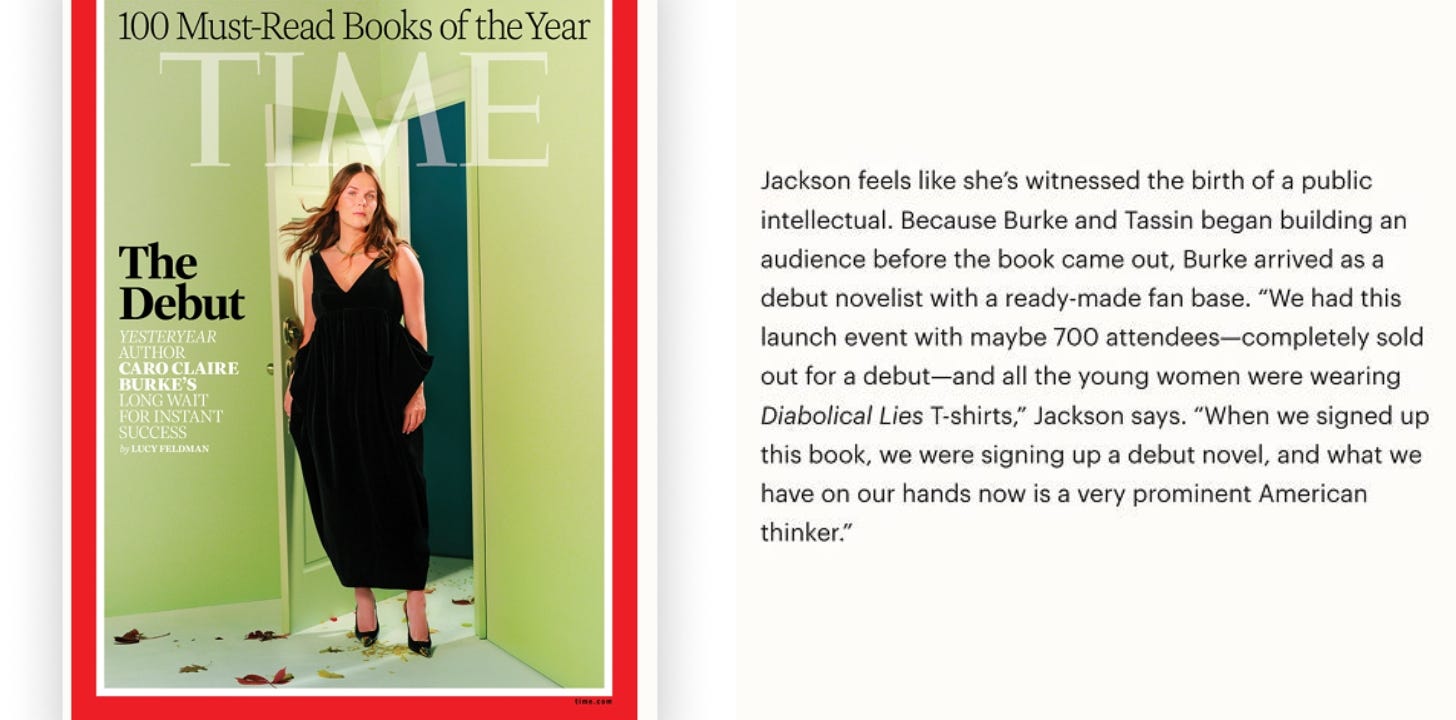
Diabolical Lies Nation, rise up.
I may or may not see you next week on the Wednesday before Thanksgiving. If I don’t, I’m wishing you the holiday that you need.
|












Comments
Post a Comment